Klara and the Sun (2026) Review: Jenna Ortega Shines in This Hollow Adaptation
Klara and the Sun focuses on observations of life through the eyes of a humanised android, aka an artificial friend, and her relationship with nature and those around her. Adapted from the novel of the same name, Taika Waititi takes on Kazuo Ishiguro’s subtle dystopian novel and cranks the brightness up to one hundred.
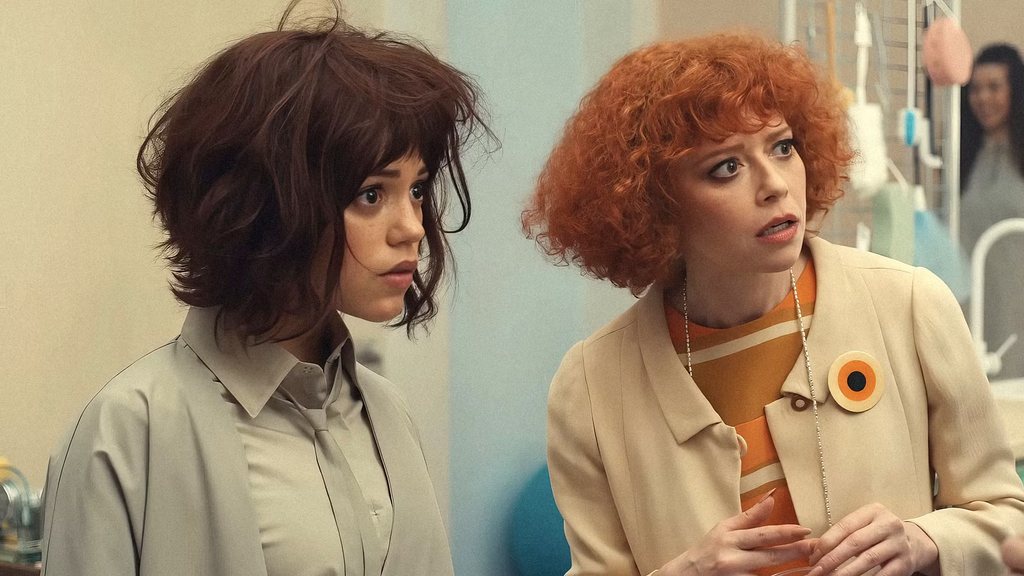
Much like Thor: Ragnarok (2017) and Jojo Rabbit (2019), Waititi has a knack for creating vibrant and distinctive worlds, and he brings that flair to Klara and the Sun. From costumes, hair and make-up to the surrounding landscape, there is an understood visual language to the so-calleld dystopia. The artifice of this saccharine world does a good job of making the audience question whether what we’re witnessing is truly the world the characters inhabit, or whether it’s all seen through the fluorescent-tinted glasses of a childlike Klara, played by Jenna Ortega.
Ortega, whom we’ve become used to seeing in moody, broody roles such as Wednesday and Death of a Unicorn (2025), defies being pigeonholed. Waititi is the light to Tim Burton’s dark, and we see Ortega completely give herself over to the role of Klara. Whether she’s descending a set of stairs, eyeing Wheat with suspicion or standing like a flamingo when she’s happy, it’s a joy to watch. Ortega makes a character who could easily have slipped into caricature come across as endearing. It’s very much Ortega’s world, and Amy Adams, Mia Tharia, Aran Murphy, and Natasha Lyonne, who also appear in the film, are just living in it. And what a world they live in.

Like much of Ishiguro’s works, including The Remains of the Day (1993) and Never Let Me Go (2010), which have both been adapted for the big screen, Klara and the Sun is seen as dystopian. Waititi’s adaptation, however, leans much further in the other direction, towards utopia. In making this drastic change, Waititi guts the underlying themes of class, religion and rebellion, filling the hollow space with comedy. Jokes are shoehorned in, slapstick is encouraged at all costs, and any subject matter that threatens to become too serious is spoon-fed and explained away with a wave of the hand, leaving the audience little opportunity to exercise media literacy or critical thinking.
In trying to make Ishiguro’s dystopia brighter, Waititi leaves the story with less to say about the darkness underneath. Ortega might be a joy to watch, but even her luminous performance can’t make up for an adaptation that mistakes a brighter world for a more meaningful one.
Rating: 2/5
Are you a Taika Waititi fan? If so, what did you think of Klara and the Sun?
Watched as part of London Film Festival 2026