Josephine (2026) Review: Childhood, Interrupted
An eight-year-old girl witnesses a violent assault that continues to haunt her and bleeds into the fabric of her family’s life.
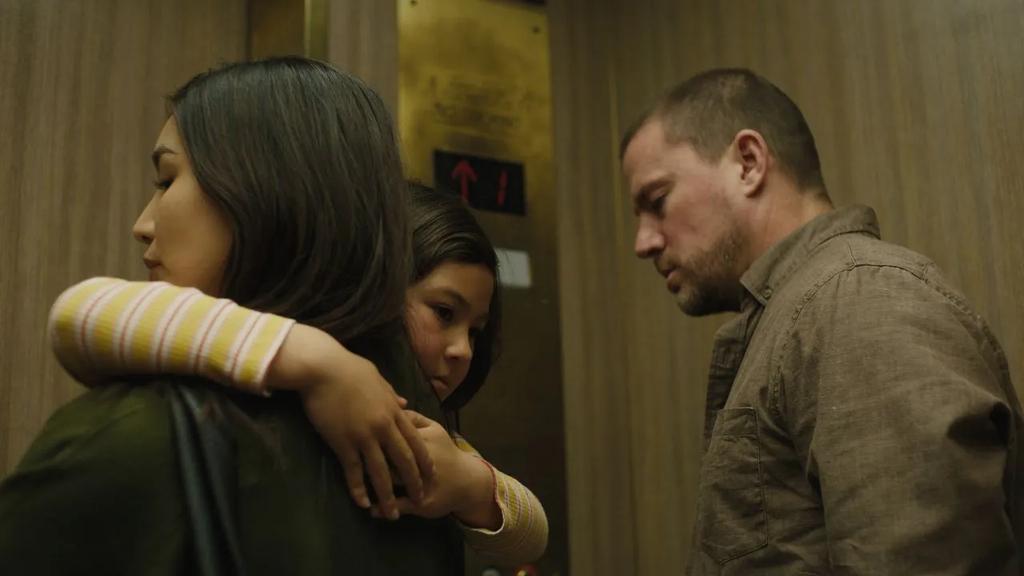
Writer-director Beth de Araújo makes a number of conscious choices in framing a story that is familiar but no less horrific.
There is also a literal grey cloud that lingers over the city of San Francisco from the very start. This use of pathetic fallacy creates a constant, looming and oppressive shadow that works in conjunction with Josephine’s experience of events, along with the muted tones throughout. This visual palette of greys and blues is unlike the typical vibrant colours used in films with children at the centre and works as a visual cue to the heaviness of the themes being explored.
When we first meet Josephine (Mason Reeves), it’s through her eyes as she looks at her father, Damien (Channing Tatum). Through the use of point of view and a low, handheld camera angle, even when it switches to a more natural, observational lens, we rarely stray from Josephine’s height. There’s a scene in the film where Josephine walks between her parents, holding her mother Claire’s (Gemma Chan) hand. As they walk, Josephine is unaware that both her parents are crying. In moments like this, it’s as if de Araújo wants the audience to always keep in mind that Josephine is a child.
But she is also a child who has experienced something traumatic, and her parents have opposing ideas about how to help her deal with what she’s witnessed. Damien tells Josephine not to be scared and enrols her in karate classes so she can protect herself. Claire pushes for Josephine to attend therapy and for them to be open and honest about what she witnessed. The film does a great job of quietly exposing the consequences of her parents’ decisions, particularly the choice not to talk to Josephine about what she saw.
After overhearing her parents talk about the rape, Josephine covertly Googles the term. At school, after beating a boy in a sporting activity, she proudly cheers, “You can’t rape me!” instantly raising concern. Josephine remains quietly haunted by the man she saw in the park, who is eerily stripped of a voice or perspective by the writer for the entirety of the film.
Josephine’s entire perspective towards men has been altered. As she walks the corridors of her school, she carries a pencil, poised to attack a male teacher walking behind her. After a boy in her class pushes her, Josephine’s reaction to being touched without consent is to string a plastic bag around his head. There is no parental rule book for this, no absolutes in what’s the right or wrong thing to do. However, the parents’ fight to maintain their daughter’s innocence is as harmful as pushing her to grow up too quickly with Damien pushing her to testify to what she saw with that well-worn phrase, “You’re mature for your age.”
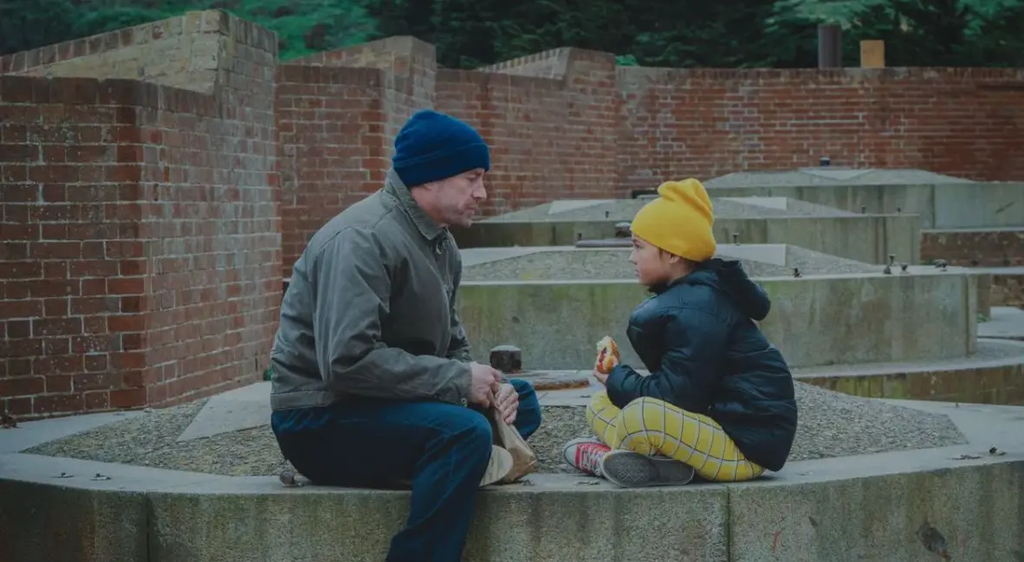
It’s a universal truth that girls, in particular, learn to grow up faster than boys, and that fear of men is instilled in them early and never truly leaves them. This is mirrored through Claire’s response when Damien tries to appease Josephine’s fears. Rather than lie and say something like what Josephine witnessed will never happen to her, Claire refuses to offer that reassurance. Through the woman in the park, who is of East Asian descent like Claire and Josephine, there is a thread of vulnerability that binds the three of them together, and a mirroring: different faces of different outcomes that all started the same, as children.
Josephine does not hinge on a specific motivation to propel us through the film. Yet, it sustains and keeps the audience interested in Josephine’s emotional spiral that has no neat or determinable fixed end point.
It’s a common device in films dealing with such weighty subjects to choose ambiguity and leave one of the fundamental questions in the narrative unanswered. In this case, was the rapist successfully convicted for his crime after Josephine’s testimony? Although narratively we’ll never know, thematically it doesn’t matter. At its core, Josephine is about how this event has changed the characters’ lives. Her view of all men has been altered, including that of her father; however, we are rewarded with a spark of hope on a lightening beach as Josephine and Damien take a step towards rebuilding their father-daughter relationship.
Josephine asks us to consider how children, especially girls, are made to grow up too quickly, while also recognising the damage that can come from trying to shelter them to preserve their innocence. There’s a bleak, that’s life quality in this duality that forces the audience to sit uncomfortably with its truth. Some lessons arrive before we’re ready for them, and the experiences that shape us in childhood rarely leave us entirely. De Araújo may be telling a familiar story, but it’s the perspective through which she chooses to tell it that gives Josephine its lasting impact.
Rating: 4/5
What did you think of Josephine?
Watched as part of London Film Festival 2026.