Fjord (2026) Review: Complicated Truths Under the Cold Eye of Society
In a remote Norwegian village, a conservative Romanian-Norwegian family goes under the microscope and through the legal system when they are accused of abusing their children. This absorbing character and societal study peels back the layers of opposing beliefs and parenting styles and lays them out on even ground for the audience to judge.
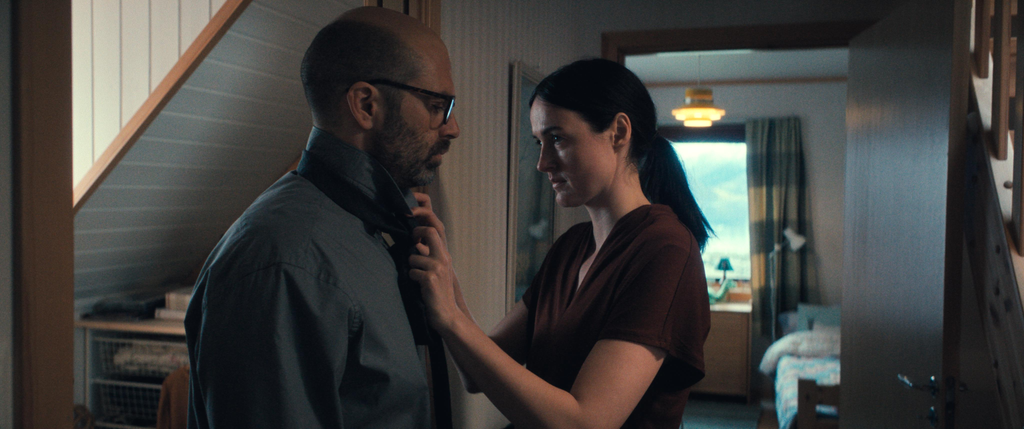
This Palme d’Or-winning film feels like an A-level exam question: What are the positive and negative sociological effects of outsiders moving into a small, close-knit community, particularly in relation to politics, religion and parenting styles? (30 marks.) The film poses a question through its script, and the audience are presented with the characters: Sebastian Stan’s brusque Romanian patriarch and Renate Reinsve’s mild-mannered wife; and the setting: a cold, remote village set in its ways. It’s up to them to interpret the film as they see fit, and no two views are the same. Although altogether lighter in tone than expected given the use of words like ‘abuse’, Fjord is heavy with its complex conversation about belief, culture and prejudice.
The isolated region of Norway, with its oppressive cold fjords, makes for a claustrophobic backdrop. Everything is stripped bare, leaving little room for the farce of a big city. Here, everyone relies on each other, and neighbours are too close for there to be any secrets.
Writer-director Cristian Mungiu doesn’t answer the question but instead creates a believable landscape, populates it with societal differences and stands back to see what happens. One thing in particular about his objective lens is that it allows for a freeing exploration of religion, specifically Christianity. Often depicted through predatory priests or saccharine sanctimony, in Fjord the characters are neither. Reinsve offers her faith to others as a source of comfort in their grief, while Stan is content with the community of churchgoers, who sit outside their immediate circle of neighbours. The children never grumble or gripe about prayers and are excited about their upcoming baptism while, in the same breath, wanting to impress their new friends by sneaking out. This is why the film might sit uncomfortably with some who are used to seeing Christianity explicitly dressed as the villain.
The set-up of daily life works brilliantly in its mundanity, making the hinge point of the children being forcibly separated from their parents hit harder.
There’s a coldness to Sebastian Stan that works; making him too warm would have aroused just as much suspicion. It’s a good match with Renate Reinsve, who is both stressed and frantic about getting her children back, but at the same time controlled and subdued in a way that makes us question her sincerity. Society and the media have instilled the idea that being overemotional is synonymous with honesty. Their slightly distant temperaments have been inherited by their two eldest children, Elia and Emmanuel, but the siblings also make an excellent case study for nature versus nurture.
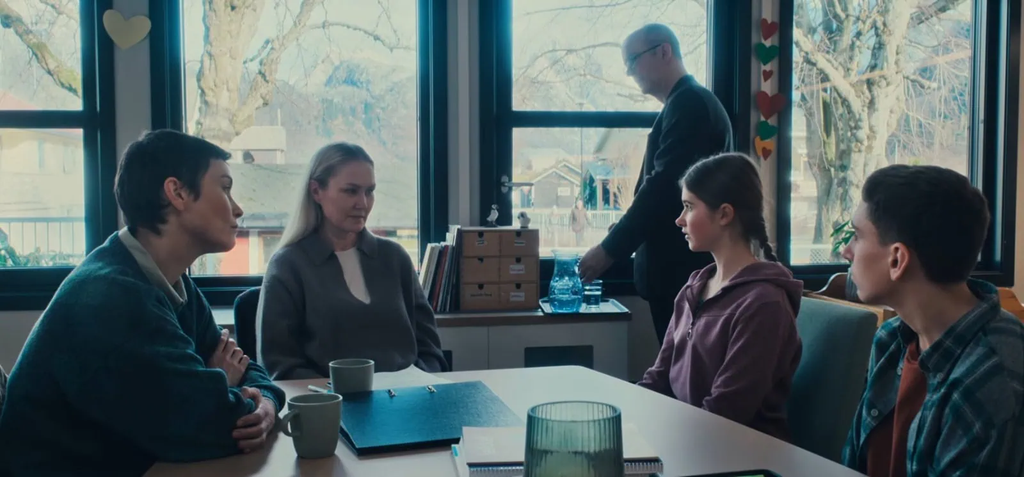
The children make fast friends with a girl their age, the rebellious Noora, who encourages them to sneak out of their house, go on midnight boat rides and defy their parents. This leads to them being grounded and unable to attend her birthday party. In turn, the siblings smooth some of Noora’s teenage angst as she starts to consider the question of faith. These teens quietly hold the secret to what could be the core truth of Fjord: both things can be true, and that’s okay. It’s a childlike world of influence without radicalisation and acceptance without prejudice.
But ambiguity is where Fjord thrives. The film leaves breadcrumbs of unanswered questions which foster a constant sense of doubt. The bruises on Elia’s back, which start the child services investigation, are never explained. When parents and children are briefly reunited, we wonder: do the children not hug their parents because they’re scared, or because they weren’t raised to be affectionate? The choice of language, with words like ‘violence’ and ‘abuse’ being countered with lighter terms such as ‘tap’, ‘slap’ and ‘push’, reinforces the duelling forces of this film. The use of the legal system raises another question: what is being put on trial? Their parenting? Or the ramifications of their culture and faith? And what are we, the audience, here to judge?
There are no absolutes with Fjord. To debate and question both sides is to appreciate the film’s motives. While a lot of the film works in its distance, the final frame is a very interesting choice. When Noora runs after Elia and appears to be walking on water, it’s as if Mungiu turns to the audience and asks us to have a little faith.
Fjord is a nuanced movie that asks a lot from its audience. It asks them to trust the process and sit with the weight of their reasoning and opinions. Both things can be true, but it’s up to us to decide which truth fits more comfortably with the narrative we’re most comfortable with. Ultimately, it’s an interesting conversation about culture and religion set against the laws of the state.
Rating: 4.5/5
What did you think of Fjord? Is the movie more cut and dry than I’ve made it out to be?
Watched as part of London Film Festival 2026.