
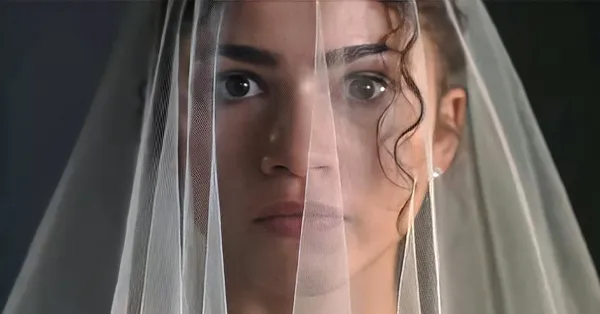
The Drama (2026) follows a couple who, just days away from tying the knot, decide to unburden themselves with their deepest, darkest secrets.

The Drama plays with the idea of intent vs action; as soon to be wed, Emma (Zendaya) and Charlie (Robert Pattinson), along with their two friends Mike (Mamoudou Athie) and Rachel (Alana Haim), tell each other the worst thing they’ve ever done. Each confession is met with very different reactions, and the question running beneath the chaos asks us whether intent to act is just as bad as action if something stops you—rather than you stopping yourself.
Emma’s confession is seen as the worst of all and shapes the rest of the movie, twisting Charlie’s view of the woman he thought he knew and Emma to question whether they still have a future.
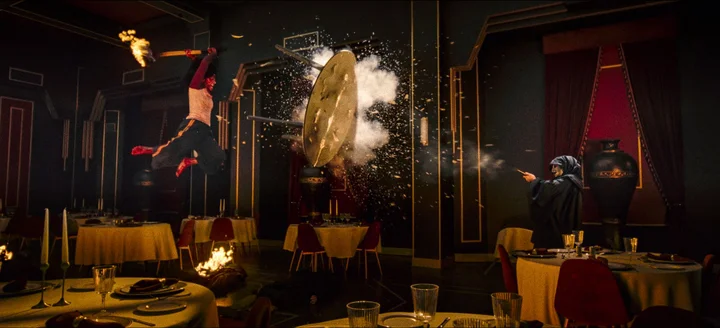
The use of imagined scenarios crashing through the narrative does a brilliant job of highlighting human spiralling thoughts and blurring the lines between fantasy and reality. There’s a scene where Mike is telling Charlie to leave Emma and go back to England, and we’re never quite sure if this conversation really happens or if it’s a product of Emma’s fears. Another moment that works brilliantly is when we see a flash forward where it looks like the entire wedding party has been murdered. This clip leaves us on edge, wracked with fear and anxiety, wondering if it will come to pass or if it’s just another intrusive spiralling thought.

The Drama poses moral questions but doesn’t necessarily give you the answers—as it shouldn’t. If you found yourself frustrated by the moral questions in After the Hunt, then The Drama might feel like an easier sociological experiment to swallow. Writer-director Kristoffer Borgli does a great job of not saying too much—allowing the audience to make up their own minds, while still giving them roads to wander down. This art of posing a question and leaving the audience to perform their own critical analysis works for the most part, but there is one area of The Drama where a key character element is underexplored.
The question of race dangles uncertainly at the fringes of The Drama. We watch as Emma is quickly ganged up on and made to feel like her “bad thing” is far worse than everyone around her. There is no real attempt to understand or empathise with what she may have been going through from her so-called friends and fiancé—only judgement. There are snippets from the past that present a subtle idea of why Emma almost does the “bad thing”, but in the present she isn’t afforded the same grace to laugh off her story in the way others are, especially Rachel and Charlie, who represent two very familiar schools of thought.
Charlie is the embodiment of a straight white male who has had a relatively easy, drama-free life. When something comes along and rocks his boat, he becomes obsessive and self-sabotaging, unable to fully empathise with someone else’s reality or mistake until he experiences it himself and miraculously finds clarity as a result. Charlie is a brilliant representation of the everyman, and he, more than any other character, holds up a mirror to society that we really don’t want to look at.
Rachel, on the other hand, is a frustrating but brilliant character. Everyone knows a Rachel—perfectly happy to point out the stick in your eye while walking around with a log in her own. From the offset, her jealousy of Emma is transparent, but it’s her internalised sense of betterment over Emma that deliciously bears fruit throughout the film. She is weaponised morality incarnate, and Alana Haim is exceptional, sipping sauvignon from her self-imposed moral high ground and making you question society’s rules solely through her own blatant rewriting of them.
Each character has their function, and The Drama does a good job of building them out to be more nuanced than their sociological representation, creating reams of topical discussion and distillations.

There is a line in the film that goes something like, “Emma always brings the comedy to my drama,” and that is a brilliant description of what this film wrestles with throughout. Moments of shock and awe are quickly offset by points of humour; for example, there is a great contrasting moment from early in the film when we hear Charlie’s wedding speech compared to its car crash delivery on the day. It’s as if we are being reminded that events have been greatly amped up to be lapped up by the audience. The film makes you cringe, laugh, gawp, and gasp, and it’s these multifaceted layers that elevate it beyond what could have been a simple dinner-table-style drama.
That said, not everything lands. The scenes featuring a young Emma could have been pushed further, as they feel somewhat randomly interspersed rather than fully integrated into the narrative.

From a performance standpoint, Alana Haim is a standout. It’s especially impressive considering this is only her fourth feature film role. Meanwhile, Zendaya brings something refreshingly different to her usual aloof and straight-faced roles. Her shift in expression and side glances bring out internalised feelings and make it easy to understand why she thought she was in a safe space when she shared the “bad thing”. There’s a sweetness, warmth, and underlying uncertainty to Emma—a sense that she’s still carrying the fears of her younger self—that Zendaya brilliantly juggles.
The use of the drug using wedding DJ as a parallel for the group’s situation is sharply observed and goes to show how one could spend hours dissecting The Drama. There are so many moments where we watch the characters fail to recognise their own hypotheses and hypocrisies, emphasising just how narrow and internalised their perspectives are and, in turn, how narrow and internalised our perspectives can be.
From a British perspective, the gravity of Emma’s confession is perhaps harder to fully grasp when compared to, say, Charlie’s, though that may be part of the film’s wider exploration of subjective morality. Ultimately, The Drama is an astute microcosm of the flawed and opinionated social spaces we live in—where the loudest voices dominate, moral lines are constantly shifting, and, more often than not, everyone loses. It leaves you with one final question: are these characters horrible, or simply human—and what does where we stand when it comes to the drama say about us?
Rating: 4/5
Views on The Drama are so varied, so what did you think?
Don’t forget to subscribe if you’d like future reviews straight to your inbox.


Any thoughts on the film?