

Nia DaCosta and Tessa Thompson create a fearless and glamorous drama.
If seeing Tessa Thompson play a manipulative, bordering on sociopathic anti-hero in a vintage 1950s gown wasn’t on your bingo card, it’s not too late. This sweltering drama from Nia DaCosta is sharp, glamorous and utterly moreish.

Based on Henrik Ibsen’s play Hedda Gabler, DaCosta’s adaptation takes calculated liberties with the source material. The biggest change is the gender swap of Hedda’s former lover and her husband’s professional rival, Eilert Lövborg. Now Eileen Lovborg (played by Nina Hoss) the change doesn’t detract from the original themes of ambition, repression and desire. Instead, it grounds them. Eileen isn’t only fighting professional failure, but the weight of existing as a woman in a male-dominated field.
Eileen’s hunger for recognition and Hedda’s frivolous discontent collide beautifully. Their relationship becomes the emotional and moral centre of the film – charged, intimate and explosive. This shift makes the story’s intended dark conclusion feel more inevitable and strangely humanises Hedda.
From the very first frame – Tessa Thompson’s Hedda, tear-stained and shrouded in a billowing widow’s robe – the tone is set. DaCosta’s direction is full of intention; the camera lingers on Hedda as she goes to work. A puppet mistress, pulling invisible strings as tensions rise and suffocate unbeknownst to her guests. One of the film’s most striking scenes sees Hedda send a drunk, drenched Eileen into a room full of peers to be humiliated. It’s cruel, and yet we can’t look away from the scene and the understanding of Hedda’s true nature.
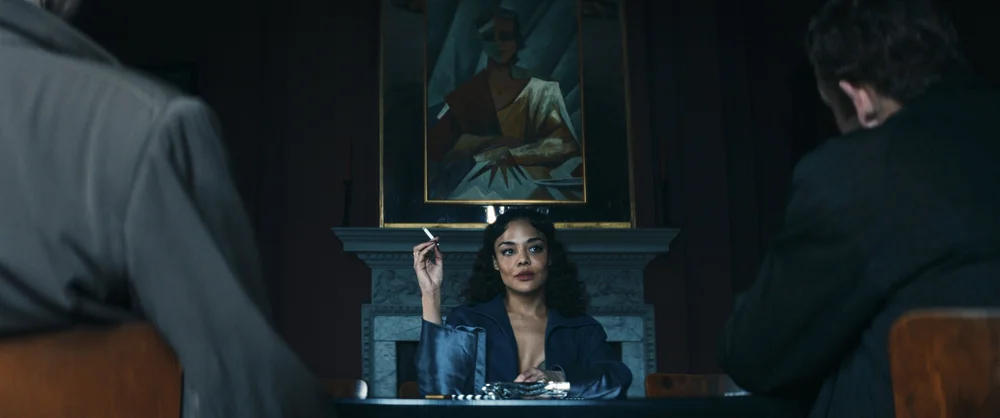
The film’s visual style is flawless: warm tones, oppressive interiors, and the kind of foggy middle-class drunken euphoria that bodes claustrophobia and simmers until it bursts. From the opening and closing of the narrative there is an inevitability. Everything in Hedda’s world is cyclical, suffocating, and built to implode and reset.
With Hedda, Nia DaCosta makes the classic her own. Through its race, gender and plot changes, this adaptation redefines Ibsen’s work for a modern audience. It’s a film brimming with dramatic tension, ambition, and the aching emptiness that comes when everything is yours for the taking, but you can’t quite hold on.
Tessa Thompson’s Hedda is an inspiration – if you gloss over her scheming, her emotionlessness and the attempted murder. Like the film itself, she’s fearless in her portrayal of a woman desperate for control in a world defined by men, yet reinforced and trapped by women’s silent endurance.




 Film Reviews & Movie Analysis
Leave a comment