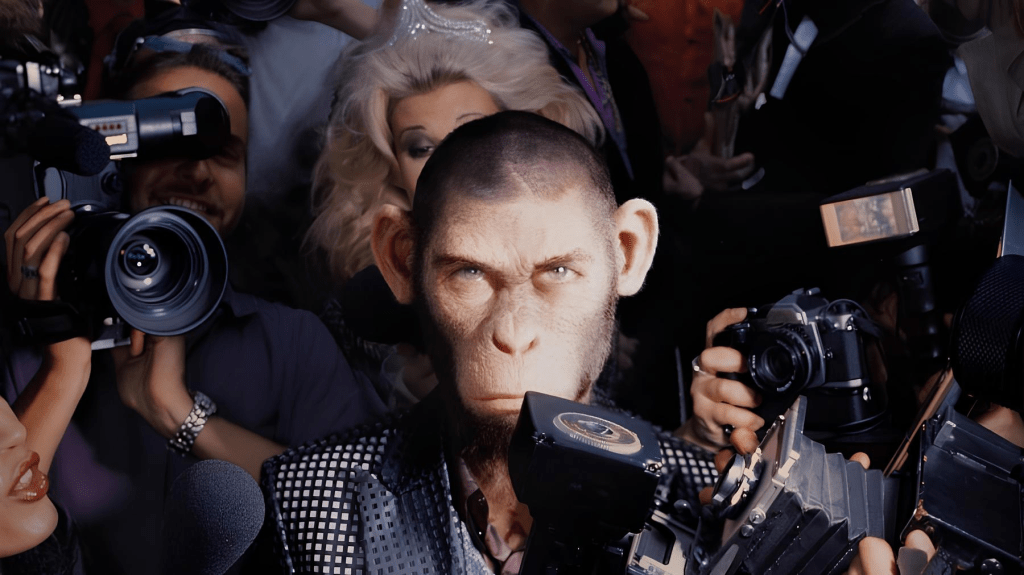
Music sensation Robbie Williams takes centre stage in this latest biopic. Well… sort of. The musical element from director Michael Gracey (The Greatest Showman) isn’t the only standout feature of this movie – it’s that Williams wanted the audience to see him as he sees himself: the good, the bad and the chimpanzee.

That wasn’t a typo, and the chimpanzee isn’t a brief interlude – it’s a staple for the entirety of the movie. And do you know what? It’s so crazy, it works.
We watch this young chimp grow from a young ‘boy’ trying to please his absentee father by choosing a life in the spotlight. Personally, it’s one of the best performances I’ve seen from a child actor in years. Williams grows into a cheeky ‘teenager’ filled with a determination that outshines the life he was born into, and eventually becomes a young ‘man’ struggling with fame and addiction as he is kicked out of Take That.
It is heartbreaking, but it’s also very clever. Because of the chimpanzee mask, Williams’ story becomes easier to sympathise with. The reality is, not many people even try to empathise with the struggling celebrity who seems to have it all.
The chimpanzee is a metaphor for Williams inner struggles and public persona – a way for him to disassociate from his life while bringing his truth to the forefront. It adds a layer of whimsy to the film while highlighting the absurdity of fame. The chimp isn’t just a gimmick; it’s oddly endearing, walking the fine line between audacious and soulful in a way that encapsulates Robbie’s persona. And I was 100% into it.
Another aspect of the film I enjoyed was the music. I don’t know much about Take That between their formation in 1989 and their original break-up in 1996, but Robbie Williams the solo artist? Him I do know. Sure, there was the nostalgia of recalling lyrics I haven’t heard in decades, but Better Man allowed us to experience his music in a new way. From the dazzling and theatrical choreography as Take That danced through Regent Street to Rock DJ to the tender partner dance of Robbie (Jonno Davies) and Nicole Appleton (Raechelle Banno) to She’s The One, the movie provided new insight into his popular hits.

I will say, despite thoroughly enjoying the song and dance, the balance felt slightly off. The film doesn’t commit fully to its musical identity, and one or two additional performances could have solidified its position as a true musical biopic.
I liked this film a lot, it shined when it showcased the chaos and camaraderie of Take That and the drug and alcohol dependent spiral Robbie fell down – but it hid behind the theatrics. Despite all the cocaine (and there was a lot of it) and the swearing (there was a lot of that too) the movie didn’t dive very deep to bring anything new to the surface.
Was Robbie really that okay with leaving, Take That? Why was he so reliant on drugs? Did he regret leaving the band? Cheating on his fiancée? Ignoring his mum’s calls? What did he learn from going solo? According, to Better Man, not much.
This might mirror reality, but it feels narratively hollow. The film misses the chance to unpack Robbie’s continued spiral, the pressures of fame, and the emotional scars that he collected along the way. The manifestation of his inner self-doubt and hatred worked well at times, but it was a one-trick-pony, leaving for an ultimately superficial and trite story of fame.

And then there was the ending, specifically the culmination of Robbie’s relationship with his father, Peter Williams (Steve Pemberton).
Peter is a selfish man. He chose his own flicker of audience attention over his son and infected young Robbie with the same idea that truly love only comes from an adoring fan base. Peter has the audacity to say to a world-famous Robbie “There would be no Robbie Williams without me” and I nearly threw my shoe at the screen. Peter is the central antagonist, however his toxic behaviour is ultimately rewarded in a way that left me seething.
It doesn’t take a psych undergrad to spot the bias in my frustration, but I still felt cheated out of the satisfaction of Peter realising he was a terrible father and then choosing to make amends.
Better Man is far from perfect, but it’s undeniably entertaining. It leans heavily on Williams charisma, nostalgia, and showmanship, while skimming over the darker depths of his story. It’s a good film and the catchy musical numbers, Williams, depicted as a ‘cheeky monkey’ and the occasionally tear-jerking moments are enough for most. However, its lack of narrative substance at key turning points in Williams life and a finale I personally found frustrating held it back for me.
What did you like most about Better Man?


 Film Reviews & Movie Analysis
Leave a comment