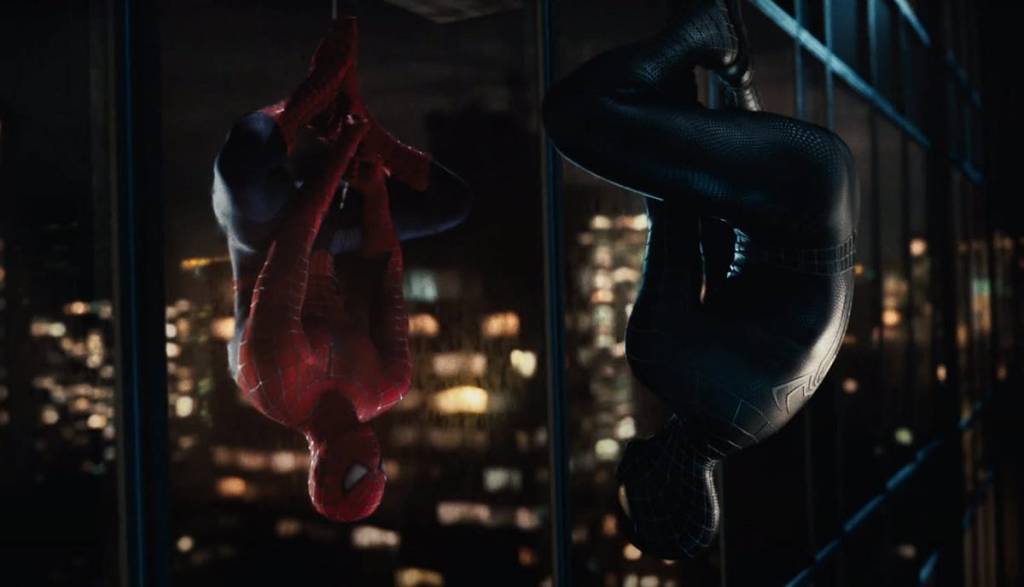
Peter Parker juggles too many identities in the final chapter of the original Spider-Man Trilogy
You might want to catch up on the first two instalments of the Unmasking Spider-Man series: Are Powers and Responsibility the True Measures of Heroism? and Identity and the War Within.
If you’ve done that then let’s get into discussing the final film in Sam Raimi’s Spider-Man Trilogy; Spider-Man 3. To say this movie undoes all the work of its predecessors is a harsh and one-dimensional statement, to a nuanced thought process.
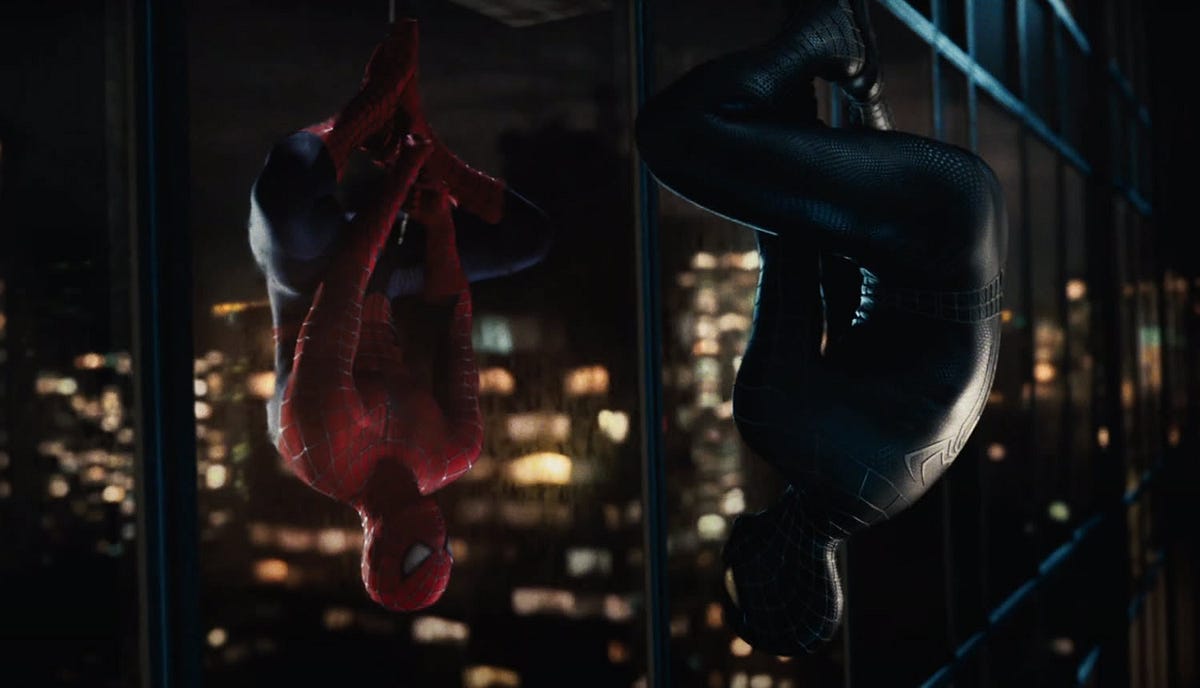
But let’s start at the beginning and applaud how brilliant Spider-Man 3 — like Spider-Man 2 — uses the opening credits to remind us what went down in the last film. Yes, I technically had no problems with recollection as I’ve been watching these movies exactly one week apart, but seriously can we bring these back?
In the generous first act of Spider-Man 3, we get that same meticulous narrative and character building that we’re used to seeing in this universe.
Peter Parker got the girl; Mary-Jane Watson, and he’s ready to take their relationship to the next level. Unfortunately, Peter is still on the outs with his best friend Harry Osborn who still wants him/Spider-Man dead for the misassigned death of his father Norman Osborn aka The Green Goblin. Peter’s grades are holding steady and now that he has reconciled himself as Spider-Man he is a beloved figure in New York.
The film establishes the norm for the protagonist, and once that’s been done, the next stage is to introduce the one thing that will upset the norm. An event or person that will add conflict, drama and discourse, unsettling the balance of Peter’s life and ultimately seeing him changed.
Here’s where we meet the fundamental problem of Spider-Man 3 because instead of choosing one main storyline with a cheeky little B Plot tacked on, the film decides to open the box of chocolate and unable to resist, takes a bite out of every single piece of sugary goodness.
The Sandman, Venom, New Goblin, Gwen Stacey, Eddie Brock, Uncle Ben, a new personality, a proposal, a sacrifice. Chomp chomp chomp.
Let’s break down the five narrative threads in Spider-Man 3.
Reviving Uncle Ben
Remember Peter’s, Uncle Ben? With great power etc etc. Uncle Ben was the catalyst for Peter’s journey into Spider-Man in the first movie, and in the sequel, Uncle B was a symbol to reflect Peter’s indecision about being the masked arachnid.
In Spider-Man 3, we learn that the thief Peter thought murdered his uncle, the man who technically fell to his death, the face tied to Peter’s guilt, shame and blame… well it turns out that guy didn’t murder his beloved uncle. It was some other dude, who we’ll get to later.
When Peter is made aware of this, he does exactly what he did in the first movie — goes after this other man, and this time he finishes the job.
The purpose of this repeated storyline was to show Peter’s change with the symbiote suit (sorry, we’ll also get to that later). However, it didn’t quite hit the mark in mirroring the first film, or add any emotional dexterity. Instead, it felt unnecessary and tired.
Work Place Drama
The Daily Bugle was always more of a fun little C Plot in the previous movies. J. Jonah Jameson’s bellows and calls for Spider-Man’s head on a pike and the Bugle underpaying Peter were funny interludes and often the cherry on top of Peter’s bad day.
Spider-Man 3 goes a step further by introducing a storyline featuring freelance rival photographer Eddie Brock and creating a rivalry between Peter and Eddie for a staff job at The Daily Bugle.
The Bugle/Brock arc is needed to form Brock’s villain origin story, and honestly, the Brock to Venom villain pipeline makes the most sense in this movie. However, his workplace drama with Peter overcrowded an already overflowing narrative.
Love Triangle(s)
The Peter, Mary-Jane, Harry love triangle has been an ongoing theme from the first movie. And, honestly, the film does a decent job of pushing this to the next level by incorporating Peter and Harry’s alter egos into the already tangled mess of emotions.
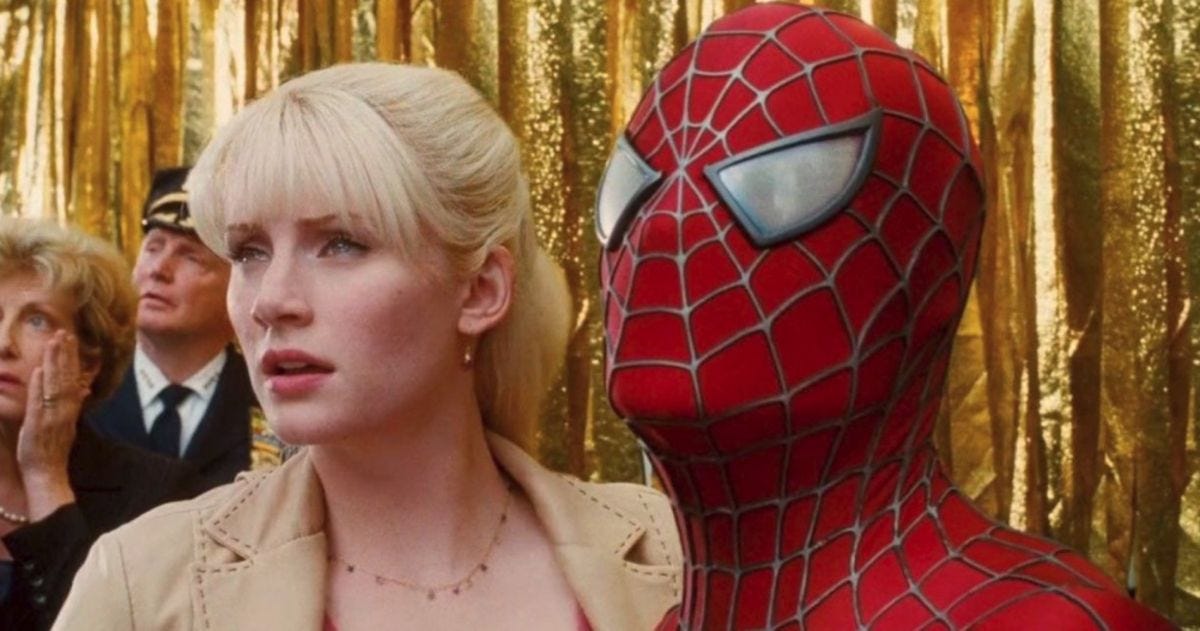
However, on top of the culmination of a love triangle we’ve been following for two movies, Gwen Stacy and Eddie Brock are tossed into the mix.
So we are clear the additional triangles include:
Spider-Man, Gwen and Eddie. Spider-Man, Mary-Jane and Gwen, and I suppose Peter, Mary-Jane and Gwen. These end up feeling like conveniently peppered conflicts for Peter/Spider-Man, which would be fine if any of them came to any real fruition within the movie.
The Villains
Now that you have some context of the storylines and characters, let’s get into the villain epidemic that swept through Spider-Man 3.
Flint Marko is the first villain we’re introduced to in the movie, and his journey to becoming The Sandman is accidental. However, as Peter Parker proved during his origin story, everyone has a choice when it deciding what to do with great power. No matter how selfless Flint’s motives are, he chooses the path of a villain.
Peter discovers The Sandman aka Flint Marko is responsible for Uncle Ben’s death. Honestly, this plot twist had the contrived purpose of showing Peter’s dark side during his symbiosis with Venom, and to later show how he lets go of his anger.
Cute, but an ‘I forgive you’ wasn’t a satisfactory end to The Sandman arc as Flint simply disappears off as dust in the wind.
The next villain is a funny one because seriously, what is Venom? And I mean this without thinking about the latest Tom Hardy franchise, where we get a better understanding of its origins and capabilities. In Spider-Man 3, Venom quite literally drops from the sky and then when it’s convenient in the storyline, fuses with Peter and Spider-Man.
We’ve seen Peter as a man, and Peter as a hero. The Symbiote suit gives us a chance to see Peter as a Villain. And It’s a fantastic concept. The natural next step in the character arc that has been built.
However, the scenes with emo-era Peter are incredibly cringe and rushed and so it became a slap-and-dash version of the identity crisis we have already seen Peter grapple with in Spider-Man 2.
Later when Peter accidentally manages to break away from Venom, the sentient blob finds its new host in Eddie Brock, who, because of the workplace drama with Peter, and the love triangle with Spider-Man, Gwen and himself is hell-bent on making Peter pay for his misconducts.
Villain 101.
The Venom/Eddie symbiosis happens so late in the movie that despite the fact we’ve had all this build-up and Venom proves a formidable foe — it sadly rounds up to be a short-lived anti-climactic blip in the narrative of the film.
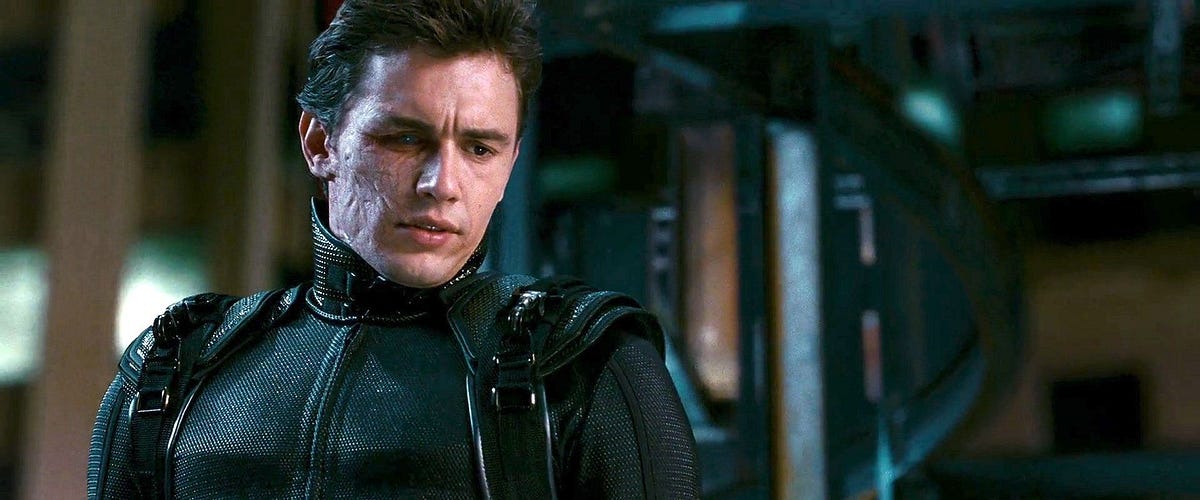
The final villain is the one that we’ve seen coming from Spider-Man and their presence book ends the movie nicely. We are talking about the New Goblin, aka Harry Osborn.
Bookend is a carefully chosen word because New Goblin isn’t terrorising Spider-Man throughout the whole film and therefore, Spider-Man 3 needed — or thought it needed — three other villains to bridge the gap; Flint, Brock and Emo-era Peter.
Spider-Man 3 has the longest running time at 2 hours 19 minutes, but even that isn’t enough to give the stories of these villains the breathing room they needed to feel like worthy adversaries.
We’re used to seeing multiple facets of Peter’s life and Spider-Man 2 handled this perfectly as there was the common theme of identity and the war within between the man and the mask. In Spider-Man 3 the five narrative strands operated separately from one another with no common theme. However, one storyline did result in a satisfying conclusion.
The Perfect Arc
Once you strip back all the distractions with Eddie Brock, Gwen Stacey, Flint Marco and even Venom, there is one arc that permeates Spider-Man 3 and calls back to its set-up in both Spider-Man and Spider-Man 2.
The friendship between Peter Parker and Harry Osborn.
Harry was always destined to become the New Goblin. We see the idolisation he had for his father Norman who favoured Peter, and Harry’s quest to gain his father’s approval in his death. This manifested in his obsession with Spider-Man’s demise and then later his blindness to the kind of man he knew Peter to be when discovers Peter behind the mask of his enemy.
Harry has a slow-burn villain arc across the trilogy which culminates in a redemption story. This echoes Peter’s slow-burn hero acceptance which is tainted by a villainous moment with the symbiote suit. Ultimately when Harry answers Peter’s call during the final battle, he hasn’t flown in on his skateboard just to save Mary-Jane.
Troy Bolton and Chad Danforth said it best; Brothers fight, and they’re still brothers.
At the end of the film, Harry proves himself to be a better man than his father, with an emotional parallel with the movie that started it all.
I can’t say what Spider-Man 3 should have been, but I can confidently comment that watching Peter and Harry grow from friends to enemies to comrades was the heart of the movie and the only strand that held the emotional depth that we’re used to seeing from his franchise. It also provided the only satisfying conclusion, and for that at least we are grateful.

It’s impossible to say which narrative arc broke the movie’s back. However, it’s clear that although Spider-Man 3 touched on the foundations laid in the first two movies; what it means to be a hero and the idea of identity, it ultimately didn’t trust itself to continue these ideologies to the end.
To be honest, at one stage, there were plans for Spider-Man 4 with Tobey Maguire reprising his role and Sam Raimi back in the director’s seat. For one reason or another Spider-Man 4 was scrapped, however, this information explains why the end of Spider-Man 3 felt both overstuffed and incomplete.
Arguably, we tie up a few loose ends with Peter’s life as Spider-Man 14 years after the end of Sam Raimi’s impactful character-driven trilogy — but we’ll get to that.
This article is also published on Medium.
Check out my film reviews on these psychological thrillers; Zoë Kravitz’s Blink Twice and M. Night Shyamalan’s Trap



 Film Reviews & Movie Analysis
Leave a comment