They say that a hero can save us, so what makes Tobey Maguire’s Peter Parker our guy?

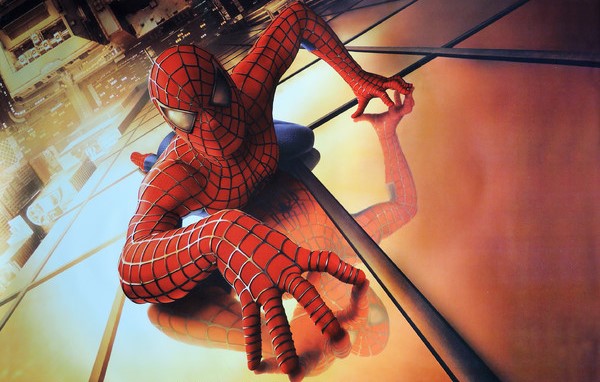
You know the story of Spider-Man, right? Dude gets bitten by a radioactive spider and develops extraordinary abilities. We’re talking, web spinning, web slinging, super strength, agility and Spidey-sense. He uses his abilities to save his local city of New York from itself and against various villains while keeping his superhero alter ego hidden from the ones he loves.
Most of us have seen Sam Raimi’s Spider-Man (2002). I watched it countless times during the noughties, but admittedly it’s been a while. Since that time the superhero genre has gone forth and multiplied at an exponential rate. From Marvel to DC to their various imprints and independent publishers having their works adapted for the big and small screen, and I don’t know about you but in the last few years I have come down with Comic Book Adaptation Fatigue (CBAF).
Getting the chance to watch Spider-Man (2002) on the big screen felt like a hard reset on a genre that has become an over-saturated, complacent money maker that relies on its previous laurels to draw in an audience, myself included.
In 2024, Tobey Maguire’s Peter Parker took things back to basics. This welcome breath of fresh air made me consider what it is that we first loved about superheroes, and in fact at its most basic; what makes a hero?
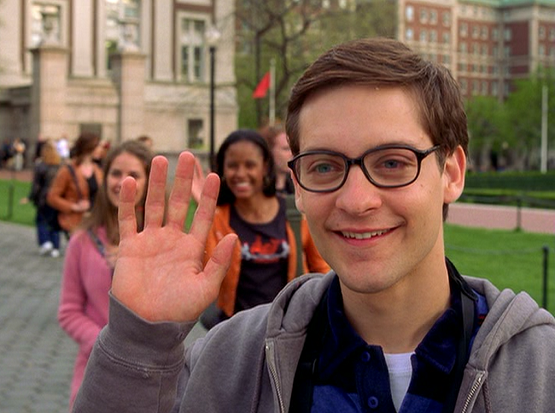
When we meet Peter Parker (in a quintessential 80s style voiceover) he is this bullied, overlooked smart guy, pining for his gorgeous neighbour, Mary-Jane Watson. Calling him an utter loser is a bit of a stretch, but we do feel bad for him, not just because high-school is a bitch, but because we know he was orphaned at a young age.
However, despite the hand life has dealt him, Peter isn’t bitter. He doesn’t walk around feeling sorry for himself or plotting revenge against his tormentors, which makes him two for two at being a better person than me. If Peter was the sort to harbour malice and bide his time to deliver his own brand of justice, then this would take him down the dark and irredeemable path of villain, and trust me, it’s a very fine line.
Peter is cut from a different cloth, not quite a universally relatable cloth but on meeting the OG Lonely Boy we can start to see how his isolation from his peers prepares him for the solitary life of a hero. He knows what it is to be weak, so when he comes into power, he’s unlikely to abuse it the way power was abused against him. The early loss of his parents has taught him that life isn’t always kind or fair, but you keep going, and the girl next door teaches him to appreciate beauty even if it won’t love you back.
And then on a casual Tuesday, Peter Parker gets bitten by a radioactive spider and everything changes.
We have to quickly talk about the glow-up. Peter isn’t given America’s ass but its subtlety is what makes it so effective and grounds him in relatability. Do you know how many times I’ve pondered and fretted over my survival in a post-apocalyptic future if I broke my glasses?
20/20 vision and a spoonful of confidence are the practical gains of Peter’s transition from boy to man, and I would take those over excreting sticky residue from my wrists any day of the week.
However, as we all know whether it’s perfect vision or web-slinging; with great power comes great responsibility.
As simple and adequately ominous as this quote is, what does it mean?

Let’s take away the fact that Peter has in fact been bestowed with great power. After all Uncle Ben had no clue how strongly those words would resonate when he spoke them to his nephew.
Being in a position of power means that you have something the masses don’t. This can be physical strength, it could be financial wealth, superior intelligence or it can even be as simple as having a platform where, if you speak, people will listen. Uncle Ben’s final words of wisdom are said off the back of Peter getting into a fight with his bully, Flash. He still hasn’t gotten to grips with his new abilities (fair enough, it had been less than 24 hours) and Peter, accidentally on purpose wipes the floor with Flash.
It’s important to note that despite how impressive Peter was, that he was on the defensive for most of the altercation, or that Flash low-key deserved it, no one (other than his best friend Harry Osborn), praises Peter for his actions. The girl of his dreams, Mary-Jane Watson, looks at him like he ran over her kitten and another kid calls him a “freak”.
Harsh, but those words (or more likely the look on Mary-Jane’s face) make Peter feel ashamed. Why? Because it’s not a good look for a hero in the making, a person with great power to go forth and harm others who either cannot defend themselves or at the very least fight on the same level.
Subconsciously, Peter is discovering, that very fine line between the path of a hero and that of villain. If his peers had cheered when he handed Flash his ass, if Mary Jane had dumped Flash and declared her love for Peter then that would lead to hubris. The brain would link dominance to fulfilment, which could lead to continued violence, which is essentially a one-way ticket to Darksideville.
But if only all lessons were so easily learnt.
Tobey Maguire may have been 26 at the time but Peter Parker was a teenage boy, and his powers do in fact go to his head an incy wincey bit. Naturally, it’s in his pursuit of a girl. The girl. Mary Jane Watson.
The plan is simple: Win a fight, get paid, buy car, get girl.
We’ve talked about great power, and how the abuse of it is not in the hero’s cards, but Uncle Ben says; With great power comes great responsibilities.

At this point, the fine line we talked about is probably still a bit too fine for Peter who cheapens his new gifts for public entertainment, and worse, expects to get paid for it. He’s promised the big bucks, $3000 which is what he needs to buy a car. Instead, the event organiser only shells out $100 before sending Peter on his way with a phrase that will come and bite him in the ass in a few minutes; “I forgot the part where that’s my problem.”
When said event organiser is held up at gunpoint and a thief steals all his cash, Peter is perfectly positioned to stop the assailant. Angry, disappointed and still salty — which we can easily relate to— Peter steps aside and lets the thief go. The event organiser is pissed, and confused. He has seen Peter perform, knows what he can do, knows that he could have easily stopped the thief. Peter revels in the circularity of the moment and offers the best line of the movie:
“I forgot the part where that’s my problem”
It is b-e-a-utiful. I get giddy thinking about the perfect delivery of this line. Peter feels vindicated, he is on a high, nothing can touch him. Sure, his plan went awry; no money, means no car, and no girl, but it’s fine he’ll try again. Peter stood up to the douche bag event organiser, he understands the game is rigged and most importantly it is becoming clear that he has power too, power he can use, or leverage at his discretion.
Peter has already forgotten his uncle’s words, but he’s about to remember them for as long as he lives, because lest you also forget; with power comes this pesky little thing called responsibility.
What Peter should have done, is put his pride to one side and stopped the gunman. That was his responsibility because he was the only one with the power to make it happen. Instead, Peter dipped his toe into the alluring abyss of darkness, and he was punished.
With great power comes great responsibility. The responsibility to protect those who cannot protect themselves and serve selflessly. Peter learns this the hard way when he discovers that the gunman he let run free goes on to murder his dear Uncle Ben.
Yeesh.
Filled with grief, and seeking vengeance, Peter inches closer to the darkness when he goes after his uncle’s murderer and I mean sure, Peter then proceeds to rough him up a bit. A couple of punches and dashing his head through a few windows, but that’s small potatoes because when the gunman begs for his life, dear sweet Peter Parker does not hurt him.
The gunman does what he does best (draws a gun), but it doesn’t go off, instead, he trips and falls out of the window and Mr Gunman is no more.
Let’s not dwell on whether or not Peter could have saved him. It happened so quickly and who knew the drop out of that window would be life threateningly far? If you ask me, this is Peter’s first taste of the life of a hero. I think Ronald Bilius Weasley said it best;
“You’re gonna suffer but you’re gonna be happy about it.”
Yes, the murdering thief meets an end which isn’t technically at Peter’s hands. This gives Peter justice without getting his hands dirty, however, the police see a masked Peter at the scene of the crime and assume he is a criminal too.
Peter is being simultaneously tempted on the precipice of good and evil once more. Evil shows Peter what he could accomplish as he stands high above, and good reminds him of the costs of his actions, or in action as the police hunt him down.
And therein lies the pattern of Spider-Man (2002): When great power is not used responsibly, it corrupts. Don’t believe me?
- Peter beats up Flash… His crush, Mary-Jane is unhappy with him
- Peter chooses to profit off his abilities… He is shortchanged
- Peter doesn’t stop a thief out of revenge… Said thief murders Uncle Ben
- Peter doesn’t save the thief… The police assume Peter pushed him
It doesn’t stop there. Later on, in the movie Peter once again chooses to profit from being Spider-Man by selling photos to The Daily Bugle. A publication determined to paint Spider-Man as a villain.
When Spider-Man kisses Mary-Jane, low-key ignoring the bro code. Mary Jane is targeted by his nemesis The Green Goblin.
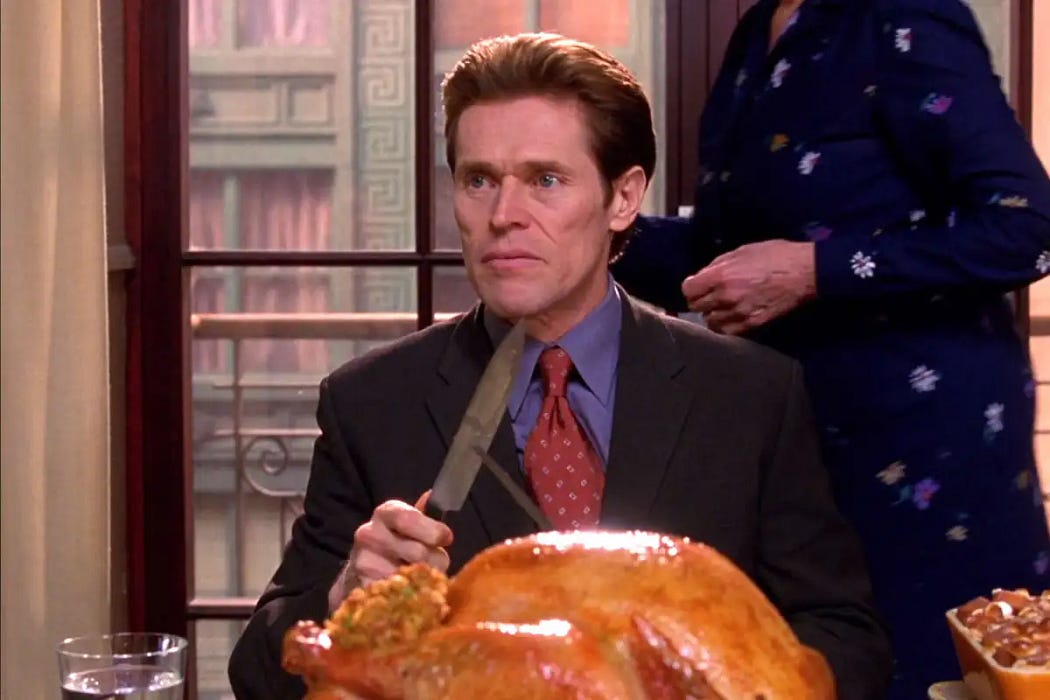
Spider-Man (2002) is a hero’s origin story, but it’s also the birth of villains too. Norman Osborn’s metamorphosis into The Green Goblin.
It’s perfect. The ultimate counterclockwise juxtaposition.
You know how parents randomly tell their kids an outlandish story of what happened to so-and-so’s kid, who is an unemployed criminal because they didn’t listen to their parents and study Engineering at university? This is that. Where Peter chooses light, Norman chooses dark. Choice is the dividing factor in their paths because Peter didn’t choose to be bitten whereas Norman knew exactly what he was getting into when he chugged that green juice.
Norman is a wealthy man who doesn’t comprehend the word no. Therefore, when a person like that gets power beyond measure, it’s not surprising that the first thing he does is murder the colleague who stood against him.
And on and on it goes. When Norman’s research loses funding, he kills the competition. When the board oust him from the company, he ousts the board from existence and puts himself on Spider-Man’s radar.
As the antagonist, The Green Goblin’s loss in this battle is inevitable in the struggle between good and evil. We see how Norman’s choices have rotted him even to his last breath where he burdens Peter with a single request, one that, as the hero he is obligated to fulfil.
Why?
Well, if you said “Because with great power comes great responsibility” then you haven’t been paying attention.
Sure, I’ve harped on about the meaning of power, and the burden of responsibility, but that’s not what we’ve seen that makes a hero. There are four key pillars ear marked in Spider-Man (2002) that show the key ingredients to becoming a hero and the first is trials.
A hero must pass a multitude of tests laid out before them. It’s okay if they stumble, or they wander through the woods of temptation, as long as they come out on the other side, not necessarily unscathed, but changed for the better. Peter’s altercation with Flash, his confrontation with the robber, being vilified in the press and quite literally having to choose between saving a bucket load of kids or the woman he loves. Trial after trial, he learns, grows and shows he’s got what it takes to be a figure we look up to. One that we trust.
The second element that makes a hero is suffering.
This is one thing that has always made my soul ache for Peter Parker. He is continuously pummelled by life, seriously, the dude cannot catch a break. And still, he rises, in a way that only a true lionheart can.
Did anyone watch the 1998–2006 series Charmed? The three Halliwell sisters discover they are witches, and must use their powers to thwart demons? Stay with me here, there is a link to the third hero element coming.
The sisters have this massive book of spells (the Book of Shadows) to help them with defeat whatever episodic evil is after them or an innocent. But there is a catch. They are not allowed to cast any spells or make any potions for personal gain. If they do, it backfires…. As we see happen with Peter Parker.
To be a hero you must be selfless. We see the consequence of selfishness when Peter allows the robber to escape. Learning from this Peter chooses not to punch Harry in the face for dating the woman he knew Peter was in love (behind his back I might add). Then at the end of the movie Peter has the chance to be with Mary-Jane, the girl next door, the woman he has been pining over since he was six years old, and what does he do? He friend-zones her.
Ouch.
But the ultimate act of selflessness Peter performs in this film, is keeping the burden of his secret identity to himself.

It’s funny because Peter doesn’t for a second consider sharing that secret with anyone. Let’s ignore the fact that his bestie Harry, who he lives with snakes him, and Harry’s dad Norman, is secretly Peter’s arch-nemesis, because Peter had months to tell Harry before all that stuff went down.
Despite being surrounded by family and friends, in his selflessness, Peter is completely alone.
The final characteristic that we see in Peter albeit very faintly, is hope, and it keeps him going. Peter has to believe that everything will work out. That he will survive, that he will be able to protect the people that he loves, that this thing that he had no say in, no cure for, that has changed his life is all for the benefit of good no matter how much it has taken or continues to take from him.
A flicker of hope amongst the trials to prove his worth, the constant suffering, and the isolating crush of selflessness doesn’t make Peter Parker Spider-Man, it makes Peter Parker a hero.
Personally, being a hero is not for me. I would be on the one-way train to the dark side after the smallest inconvenience and I’d enjoy my cookies on the way.
Don’t gape at me. Have you ever wondered why we relate to Peter at his worst? Be honest. Would you walk away from a fight you knew you could win against someone you didn’t like? Would you help someone who had moments before cheated you? Would you betray a friend if you knew you wouldn’t get caught?
Being a villain is easy. Look at Norman Osborn, his transition from man to goblin was seamless. As his name tells us, he is the norm.
Being a villain is easy, being a hero is hard work.
The battle isn’t just what we see on the outside, but the constant internal struggle to stay in the light, to keep fighting the good fight despite everything telling you to quit. It’s getting up and going out day after day saving people who will congratulate you today but condemn you tomorrow.
We lord the status of hero; we impress the grandeur of it and repeat the rhetoric that with great power comes great responsibility, without ever having had to carry the true meaning of the word. To live the thankless and lonely life of a hero.
It’s not a path many of us would choose to be on despite what we’d have ourselves believe.
Heroism is not for everyone and that’s okay, that’s why we are so drawn to stories of superheroes. For 121 minutes as we watch the origin story for Tobey Maguire’s, Peter Parker unfold we are rooting for him to be the best version of himself for himself, and for us. Those of us who would embrace the dark in a heartbeat but still need to be reminded of the light.
A hero’s job is never done, and Peter Parker’s journey has just begun.
Webbed hero, Spider-Man is swinging back onto your cinema screens across the UK. Once a week between August 2nd and September 20th, 2024, you can watch Tobey Maguire, then Andrew Garfield and finally Tom Holland take on the role of New York’s, friendly neighbourhood Spider-Man.


 Film Reviews & Movie Analysis
Leave a comment